Where tradition
meets the edge.
“For over six centuries, Seki has been Japan's city of blades — producing swords, knives, and precision cutting tools with an unmatched depth of craft knowledge.”
Located in Gifu Prefecture, Seki has been a blade-making centre since the Nanboku-cho period of the 14th century. Its geographic position — access to quality iron sand, abundant charcoal, and the Nagara River — made it a natural hub for the craft.
Over centuries, that foundation of raw material access gave way to accumulated skill. Generation after generation of blade smiths, grinders, and finishers developed and passed down techniques that are still active today. Seki now produces a significant portion of the world's professional cutting blades — from surgical instruments to chef's knives to haircutting shears.
Katana Edge shears are produced by craftspeople working within this tradition — specialists who dedicate their skills to haircutting tools, applying the same standards of precision and material quality that Seki has always been known for.
Seven stages. No shortcuts.
Steel Selection
Everything begins with the steel. Katana Edge shears are made from 100% refined Japanese steel — selected for its consistency, hardness, and ability to hold a fine edge. Not all Japanese steel is equal; blade steel undergoes strict quality control before entering production.
Forging & Shaping
The raw steel is forged and shaped into blade blanks through a controlled process that establishes the blade's fundamental geometry. This is where the foundation of cutting feel and balance is set.
Heat Treatment
Heat treatment is one of the most critical — and most easily done wrong — stages of shear production. The steel is hardened to a precise Rockwell hardness that balances edge retention with resilience. Undertreated steel dulls quickly. Overtreated steel becomes brittle. Seki craftspeople have refined this calibration through generations of blade production.
Blade Grinding & Geometry
Each blade is ground to its precise profile: the hollow, the spine, the edge bevel, and the ride line. The geometry of the grind determines how the shear will cut — how it feels through the hair, how much resistance it creates, and how long it maintains its edge.
Convex Edge Finishing
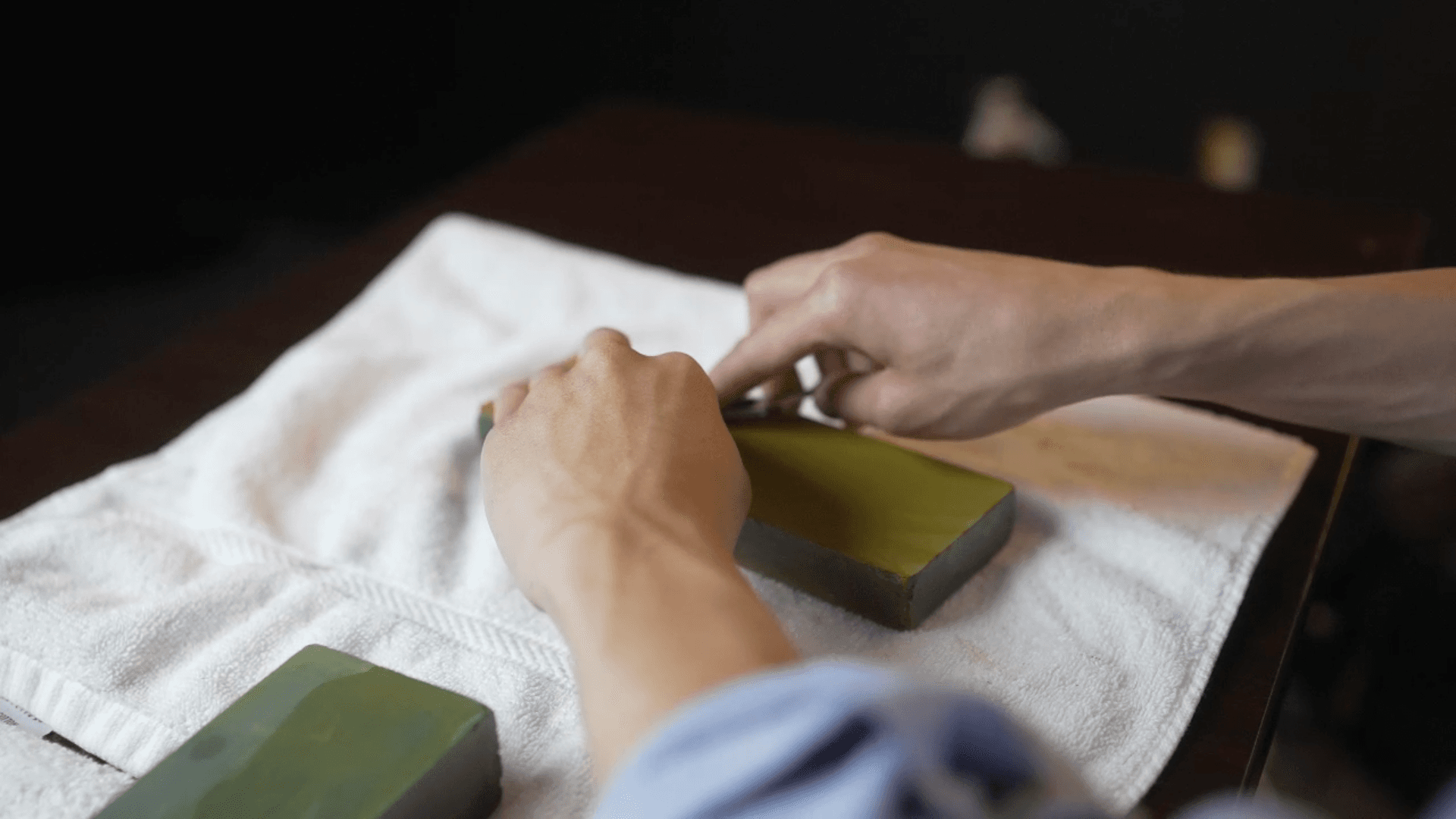
The convex edge is the defining characteristic of a true Japanese shear. Unlike the bevel edge produced by most western sharpening methods, a convex edge is rounded toward the cutting line — reducing friction as the blade moves through hair, creating a cleaner cut, and allowing the blade to stay sharper longer. Each Katana Edge shear is hand-finished to a convex edge by craftspeople who have spent years mastering this technique.
Assembly & Tensioning
The two blades are matched, assembled, and tensioned by hand. Tension is critical: too tight, and the shear fatigues the hand; too loose, and the blades fold rather than cut. Each shear is tested by a craftsperson before it leaves the workshop.
Final Inspection
Every finished shear is individually inspected — checked for blade alignment, edge consistency, handle fit, tension, and overall finish quality. Only shears that pass are approved for packaging and shipment.
The edge that makes the difference.
Most shears sold outside Japan are sharpened to a bevel edge — a flat grind that is easier and faster to produce, but creates more friction as the blade moves through hair. The bevel edge dulls faster, and when it dulls, it tends to fold or compress the hair rather than cutting cleanly through it.
Japanese shears — including all Katana Edge models — are finished to a convex edge. The convex profile curves outward toward the cutting line, reducing friction dramatically. Hair parts as the blade moves through it rather than being pushed. The result is a cleaner cut, less hand pressure required, and an edge that holds its quality significantly longer.
The challenge is that maintaining a convex edge through sharpening requires specific skill and technique. This is why Katana Edge provides professional sharpening support — to ensure your shear never loses its original edge character.
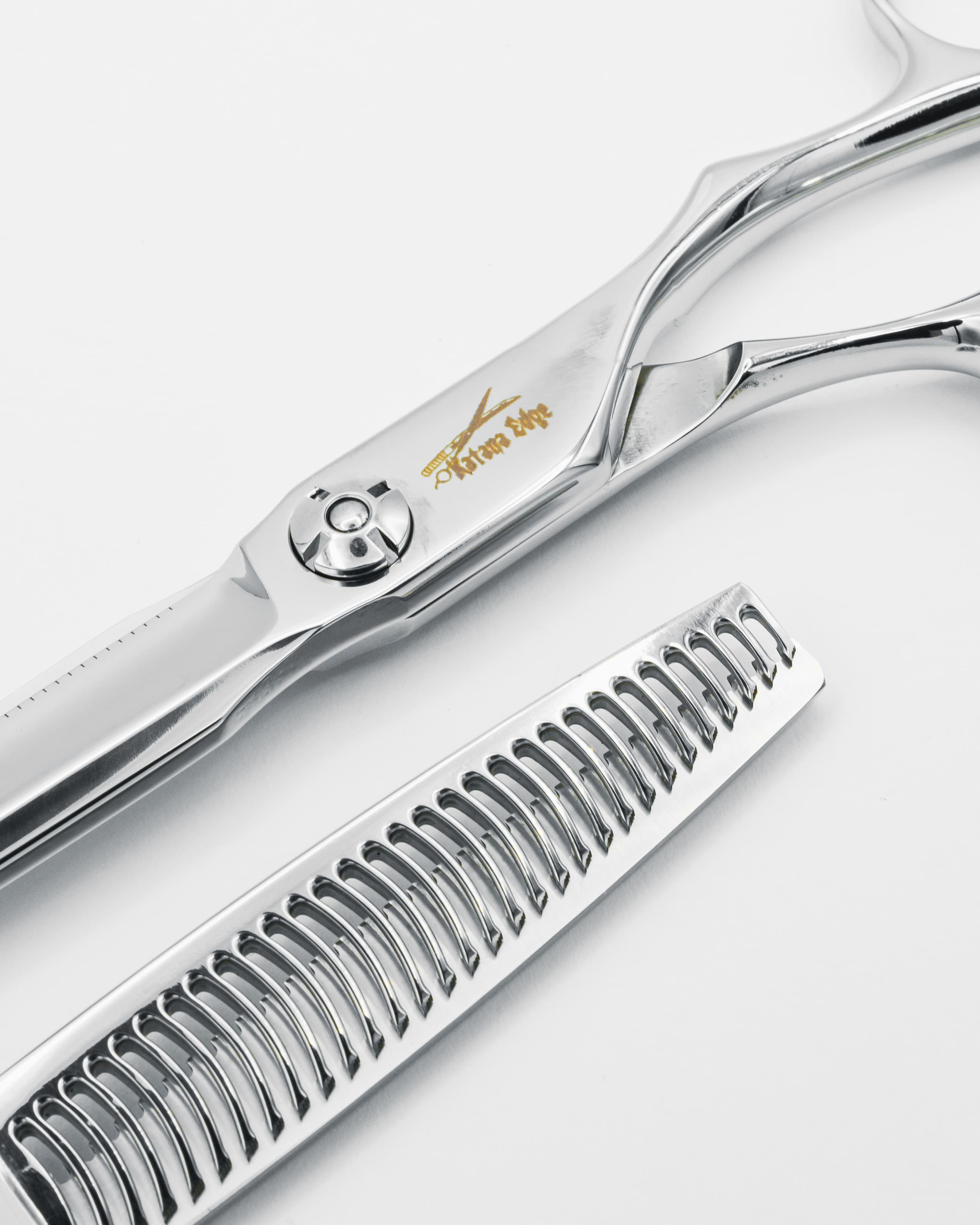
The result of this craft is in your hands.
Every detail described on this page — the steel, the heat treatment, the convex edge, the final tensioning — is present in every Katana Edge shear. The process does not change based on price point. Every model holds the same standard.
That is what it means to be made in Seki.